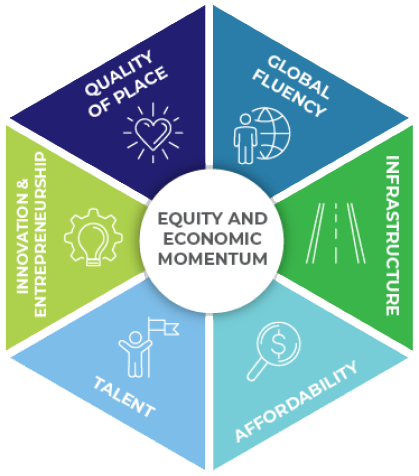
Economic Momentum
Complete 
2021 was a year of opportunity and challenge in the Charleston region. Some businesses flourished while others struggled to survive due to uncertainty and ongoing disruption driven by the COVID-19 pandemic. In the decade leading up to 2020, the Charleston region experienced sustained population and job growth.
Quick Facts
- 1 400,000 employees across all sectors, a 30% increase from 2010
- 2 2.9% regional unemployment rate in September 2021, nearly recovered to pre-COVID unemployment
- 3 $19 median hourly wage in the Charleston Metro in May 2020

Equity
Complete
The Charleston region thrives when all residents regardless of race, gender or other socioeconomic characteristic receive a high-quality education, obtain living wage jobs, live in housing they can afford, maintain good health, benefit the region’s economy, and enjoy the area’s place-based assets.
Quick Facts
- 1 28% minority residents live in Census tracts with a high social vulnerability index
- 2 2x Black residents are twice as likely to live below the Poverty level
- 3 19% decrease in low wage jobs in Charleston County in August 2021 compared to January 2020

Affordability
Complete
Housing attainability is indisputably a top priority in the region – housing is the single greatest expenditure for nearly all households. Over the past year, the ongoing surge in new households combined with individual income losses and financial uncertainty renewed the sense of urgency around the need to meaningfully address housing attainability.
Quick Facts
- 1 89,600 estimated households experiencing housing cost burden in 2019; (30% of households)
- 2 $13 million emergency rental assistance granted to 2,500 households within Charleston and Berkeley counties
- 3 62% business survey respondents report affordability negatively impacts their ability to attract new hires

Global Fluency
Complete
International trade inherently connects the Charleston region to the global marketplace. The region is home to over 180 foreign-owned businesses and nearly 42,000 foreign-born residents.
Quick Facts
- 1 180+ foreign-owned businesses operating in the region
- 2 42,000 regional residents born abroad, the largest share from Latin America or Central America
- 3 70% Port of Charleston imports and exports carry cargo between the region and Asian markets

Infrastructure
Complete
A growing region and a lack of funding have increased the burden on our infrastructure over the past decade. In the middle of a national push to invest in modernizing the nation's infrastructure including broadband, interstates, bridges, and rapid transit - COVID-19 substantially changed infrastructure demand. More people than ever before are working and learning from home.
Quick Facts
- 1 80% regional workers primarily commute to work by car alone
- 2 7% increase in the share of commuters traveling more than 30 minutes to work between 2010 and 2019
- 3 6% regional workforce worked from home prior to the pandemic

Innovation & Entrepreneurship
Complete
Innovation has never been more important than it is today. While there is little certainty in what the future will bring, one thing we can know for certain is that we cannot rely on actions of the past to bring us success long-term. Innovators and entrepreneurs in the Charleston region are the drivers of change and long-term prosperity.
Quick Facts
- 1 52% increase in knowledge based employment from 2010 to 2021
- 2 36% regional patent production occurred within priority clusters
- 3 50% existing jobs at risk of automation using presently available technologies

Quality of Place
Complete
In the Charleston region historic walkable centers, newer suburban areas and rural communities combine with water-related natural and cultural resources of international recognition. This attracts tourists year-round and remains a strong selling point to new businesses, residents and retirees who visit the region.
Quick Facts
- 1 31% increase in home values in Downtown Charleston, home to many walkable neighborhoods
- 2 7% decline in households with a commute less than 30 minutes since 2010
- 3 73% survey respondents want to live near a park, green space, or natural area

Talent
Complete
In a region rich with opportunity, developing, attracting and retaining talent are critical elements to sustaining growth long-term. Local talent development is realized in our public schools, workforce development programs, technical colleges and universities.
Quick Facts
- 1 36% regional population over the age of 25 with a bachelor's degree or higher
- 2 8,400 college graduates in 2020 across the region
- 3 7% decline in the labor force participation rate from 2010 to 2020